
How to save the world and reduce your ecological footprint—CO2—with an electric bike or city bike

The amount of CO2 (carbon dioxide) in our atmosphere has reached an unprecedented level. For 1500 years, it remained stable at 275 parts per million. When the Mauna Loa Observatory (USA, Hawaii) measured it in 1958, it was 315 parts per million. Today it is 414.7 parts per million and rising. Climate change is happening right now. The planet's average temperature has risen by two degrees over the past century. The world's population is expected to grow from its current 7.7 billion to 9.7 billion by 2050. Our global leaders recently attended a climate conference amid a great deal of media fanfare, but it seems that all they arrived at were vague promises.

In 2017, global carbon dioxide emissions grew by 1.4%. That may not sound like much, but let's put it into a slightly different perspective: it is equivalent to adding 170 million cars to the roads. The amount of carbon in the atmosphere rose by another 2.1% in 2018. In 2019, CO2 emissions rose a little more slowly: by 0.6%. Nevertheless, they reached yet another record high.
And why should you care about CO2? What does any of this have to do with electric bikes or regular bicycles? We'll get to that shortly.
But first, let's look at what Electra has done to reduce its ecological footprint.
Reducing the CO2 involved in making Electra bicycles
It makes sense for a bicycle company to care about the environment. After all, Electra makes products such as electric bikes and city bikes, which offer solutions to many of the world's most complex problems—traffic congestion, health and climate change. But manufacturing them also leaves an ecological footprint.
Trek (Electra's parent company) and all its subsidiaries, including Electra, have decided to commit to taking real steps to reduce their environmental impact. They certainly don't have all the answers yet, but every day they learn more about what could be improved. They continue to explore every possibility, and by sharing our progress and knowledge, we hope to inspire and educate others too. It is important to understand that all of us (yes, you too, dear reader) can actually do something together to start tackling the climate crisis, one piece at a time. Every big change begins with tiny things, and when many people do small things, for example, the impact is already very significant.
In 2020, Electra worked with WAP Consultingto measure the impact of the entire company's emissions over the course of a year. This helped identify what to look out for and where to direct resources to reduce the carbon dioxide associated with operations and production. Here is a closer look at some of the key points:
· Reducing air freight
Transport accounts for the largest percentage of the company's carbon dioxide emissions. In other words, the “hippo” is in the air. To address this problem, the goal is to reduce air freight by 75% by 2024. There are only two ways to get bicycles across the oceans: air freight and sea freight. A plane is, of course, exponentially faster than a ship, BUT its carbon footprint is 84 times larger. Electra believes that the volume of air freight used in the past is not sustainable, and is working hard to drastically reduce its dependence on this shipping method. To do so, it is improving its planning process in collaboration with suppliers and forecasting demand for goods more accurately.
· Greater use of reusable and recyclable materials
A commitment to using alternative reusable and recyclable materials: whether recycled or recyclable, reclaimed or refurbished. Research and development teams have been tasked with constantly looking for opportunities to use reusable and recyclable materials in making products.
Plastic from the ocean
The Ocean Conservancy reports that 8 million tonnes of plastic enter the world's oceans every year. NextWave Plastics is an association that aims to find solutions to the enormous amount of plastic plaguing the oceans. As a founding member of this association, Trek is working with other members to create the first global network of ocean-bound plastic supply chains, effectively “locking” these materials into its products and packaging and inspiring others to join them in becoming part of the solution to making the oceans freer of plastic.
One lovely example of this is the Electra Plasket Basket. Making one of these bike baskets uses 450 grams of plastic recovered from the ocean. This bike basket is designed to make two things easy for you: reducing plastic waste in the oceans and conveniently carrying your essentials—books, a handbag, a sandwich or something similar. The bike basket has a separate bracket, also made from recycled materials, which easily snaps onto your bicycle's handlebars. This lets you quickly attach or remove the Plasket Basket from your bike as needed.
Recycled aluminium
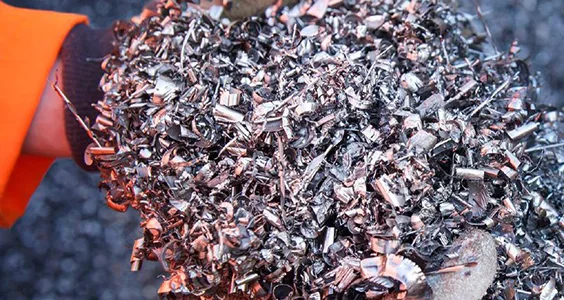
All aluminium is produced from bauxite (AlOx(OH)3–2x) ore. Using recycled aluminium saves 90–95% of the energy required to use refined bauxite ore. Aluminium is a key material for every bicycle manufacturer. It is affordable and lightweight, and can be shaped into a variety of stylish, durable bicycle or electric bicycle frames. It is also one of the more costly materials in Electra's supply chain, requiring enormous amounts of energy to extract it from bauxite ore. Refining the ore releases several toxic residues, which require additional expenditure to prevent and mitigate pollution. Previously, before the coronavirus crisis, Electra bicycles contained 30% recycled aluminium. But now that demand for bicycles worldwide has far outstripped supply, the recycled aluminium content has unfortunately fallen to 15–20%, and even lower on some models. So I would like to make an appeal here: never throw away aluminium cans, tealight cups and the like. Take them, for example, to Kuusakoski. Kuusakoski has also organised a great campaign to collect tealight cups, with an Eelctra electric bicycle as the grand prize! See the terms for taking part in the campaign here: https://www.kuusakoski.com/et/estonia/ and be sure to join in! This way, you help us use more recycled aluminium in production and thus reduce the carbon footprint of your next bicycle or electric bike. Aluminium is an excellent material, by the way, because it retains its structural integrity no matter how many times it is reprocessed and recycled.
Removing plastic waste from packaging
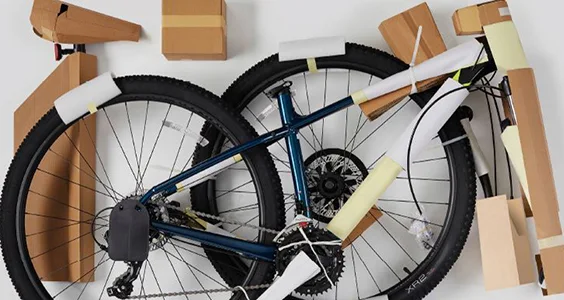
When you buy a bicycle from a shop, you probably have no idea how much cardboard and plastic it takes to package a single bike so that it can cross the ocean intact and unscratched. Packaging bicycles is a rather “dirty” business. Shipping bicycles over long distances and ensuring that they reach the bike shop undamaged requires plenty of forward planning and, unfortunately, a lot of wasted materials too. Keeping a bicycle secure in its shipping box requires many different plastic items: bubble wrap, foam, protectors, fastening straps, plastic bags and other material destined for landfill. Electra is already working on this problem. The use of plastic materials in bicycle packaging has already been reduced and will be reduced further in the future. Since 2022, a new 100% recyclable bicycle packaging box has been in use to deliver bicycles to bike shops.
In numbers, it looks like this: 5715 kg of plastic waste has been removed from Electra city bike packaging alone. 29 665 kg of plastic has been removed from Electra electric bike packaging.
If you cycle about 692 kilometres instead of driving, you will have saved the amount of CO2 that was generated in making your bicycle.
The 692-kilometre principle
If you replace your car journeys with bike rides to work, school, the shops, the gym or wherever you want to go, you too are making your own small contribution towards a carbon-free lifestyle. In other words, once you have ridden your bicycle for about 692 kilometres, you can be proud—you have offset your bicycle's carbon dioxide cost. If your bike could talk, it would say to you: “Hey, thank you for doing your bit for our planet!”
The maths behind 692 kilometres
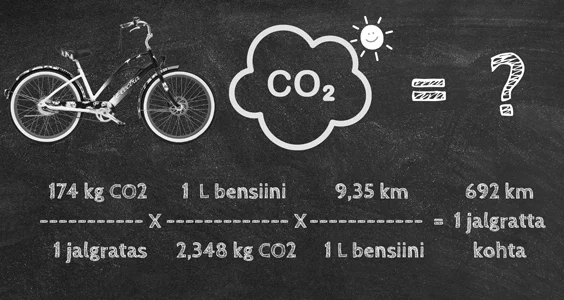
Producing one Electra city bike generates an average of 174 kg of carbon dioxide. One litre of petrol releases 2.348 kg of carbon dioxide. An average vehicle travels about 9.35 kilometres on 1 litre of petrol. 174×9.35÷2.348=692.89
The 692-kilometre principle is a guideline based on an estimated average for Electra's most popular 2019 models. It is worth remembering that the specific distance needed to offset each model will, of course, vary slightly.
Let's look at the CO2 footprint of electric bicycles in terms of their use:
An electric bike's CO2 footprint depends mainly on how much it is actually used. In other words, the more kilometres an electric bike is ridden, the smaller its average CO2 footprint per kilometre becomes, because most of the energy is consumed during production, not riding.
Together with TÜV Rheinland Energy GmbH, the CO2 footprint of producing an electric bike with a Bosch motor has been tested and assessed in accordance with the established ISO 14067 standard. Around 75% of the CO2 footprint of an electric bike with an assist motor comes from production, 15% from actual use, and the rest from transport, packaging and recycling.
Using an electric bicycle with a Bosch motor over its entire lifetime: the electric bicycle's CO2 footprint is about 14 g per kilometre. Looking only at riding itself, and thus at the emissions caused by electricity consumption, the average CO2 value is 2–5 grams per kilometre (depending on the electricity supplier and how the electricity is generated). By comparison, a car's CO2 footprint is about 150 grams of CO2 per kilometre, and local public transport produces 60 to 80 g of CO2 per kilometre (per person).
The path to sustainability is a BIKE PATH
Bicycles are the world's most efficient means of transport. Their potential to help the planet is undoubtedly great, but using bicycles for transport is not that simple. Questions need to be addressed, such as: “How am I supposed to get from point A to point B when even our beloved Tallinn is designed primarily for cars?” People probably won't start using bicycles instead of cars en masse until cycling is made safe and convenient. So we should certainly continue investing in bike paths.
Facts from the United States (Electra is a US company):
28% of US CO2 emissions come from the transport sector.
That adds up to 2061 million tonnes of CO2!
Of those 2061 million tonnes of CO2, 45.1% comes from passenger travel by car.
And 59.4% of those journeys are under six miles, or 9.65 kilometres.
The data comes from the US Department of Transportation.
In Europe, 30% of CO2 emissions come from transport. And in Europe, people's average car journeys (to work, the shops and so on) are also under 10 kilometres and .
After all, 10 kilometres is not an unthinkable distance to cycle. Especially if you're sitting on a comfortable bicycle or electric bike—and let's imagine that there were excellent bike paths everywhere. Amsterdam, known for its cycling infrastructure, sets a great example here. There, bicycles account for 40% of journeys over the same distance! In Copenhagen's cooler climate, cycling accounts for 24% of journeys. Here in Estonia, it is certainly much colder than in Denmark, but unfortunately we still lag behind the Finns, for example, where it is even colder and there is more snow.
It is also a fact that bicycles can change the world by replacing polluting forms of transport. Once again, we come back to the point that better cycling infrastructure is needed if bicycles are to fulfil their potential in fighting climate change. We can already see that when excellent bike paths are built, people actually start using them.
It would be wonderful if bicycles replaced cars entirely, but this is not realistic for many people, especially those who commute from the countryside into town, for example. Yet a distance of under 10 kilometres could be just the right length for an enjoyable bike ride. That distance is easy to cover (if there is a bike path), and when there are traffic jams in town, you can even keep up with a car over that distance on a bicycle. So your small contribution and the example you set matter too.
Calculate your ecological footprint and think about what you could do to reduce it https://jalajalg.positium.ee/.
Tip: for example, start by setting yourself the goal of occasionally travelling shorter distances by electric bike or regular bicycle instead of by car. It's good for both your health and our planet's! 😊